I had the opportunity to attend and participate in the 23rd Annual National African American Read-In today at Auburn University. Unfortunately, I couldn’t stay long before leaving to teach a class, but I really enjoyed the excerpts from Charles Blockson (Damn Rare: The Memoirs of an African-American Bibliophile) and Zora Neale Hurston (Their Eyes Were Watching God—classic!) that I got to hear. Created by the National Council of Teachers of English, the program encourages reading as an instructive and revealing activity while also promoting the appreciation of African American literature, during Black History Month and beyond.
I read from Trudier Harris’s “Cotton-Pickin’ Authority,” an essay from her collection of autobiographical pieces titled Summer Snow: Reflections from a Black Daughter of the South (2003). Harris is a native Alabamian and reflects on growing up in Tuscaloosa in the ‘50s and ‘60s. In “Cotton-Pickin’ Authority,” she raises the particular topic of inter-generational conflicts, what she calls the “then” generation (of those who barely got to go to school and had to work in the cotton fields) versus the “now” generation (of kids who had the luxury of going to school all day instead of picking cotton). The older folks invoked cotton-pickin’ authority at every turn, whenever it came to letting the younger folks know how good they truly had it. It’s very funny and very insightful about a way of living during an interesting time of change in the South.
What I liked most about the Read-In is that I got to use it as an opportunity for my lit students to sit in and learn about some writers they had never heard of. For a few extra points, I’m asking them to think about why something they heard might be worth exploring in more depth. I hope they really let their minds work on this one. :-)
This event was just one of hundreds occurring at various, colleges, universities, libraries, and other organizations across the nation throughout the month of February. Be on the lookout for a Read-In where you live, and join in this celebration of African American literature and history. See the National Read-In’s official site for more info!
About this Blog
The title of this blog, "I'm About to do My Thing," was inspired by Jill Scott's introduction to her poem "The Thickness" from her live album Experience: Jill Scott 826+. In this intro, she warns that the content to follow is "real" and proceeds to deliver a beautiful message about self-esteem in young black girls, what can influence and damage that self-esteem, and the entire village's responsibility--"it takes a village"--to elevate its children.
Monday, February 6, 2012
Thursday, February 2, 2012
Black History Fever--Web 2.0 Style!
The intricacies of social networking can get downright infuriating at times--worrying about privacy issues; being exposed to pure, unrestrained idiocy and bigotry; etc.--but I also love that we get to share good things with so many people instantly. For that, I am truly thankful and excited.This brings me to the Black History fever I've been feeling and seeing since yesterday, as evidenced on none other than Facebook! A number of users, including me, have been using their status updates to share with their comrades various facts that involve African-Americans. Here are just a few from Feb. 1-2, 2012:
- Day 2: Gotta throw my boy in here. - August Wilson (April 27, 1945 – October 2, 2005) was an American playwright whose work included a series of ten plays, The Pittsburgh Cycle, for which he received two Pulitzer Prizes for Drama. Each is set in a different decade, depicting the comic and tragic aspects of the African-American experience in the twentieth century.
- Francis Cecil Sumner was the first African American to receive a Ph.D. in Psychology...known as the "Father of Black Psychology"
- One of the most gifted writer of the last century, Richard Wright is a Natchez/Jackson MS native. From humble beginnings to the toast of Paris, two of his books, Black Boy and Native Son, are essentials in anyone reading library. Using his characters to describe the terrible treatment and conditions, many blacks faced in the 1940's and 1950's, he put into words what very few had the ability to do. We salute you..this 1st day of Black History Month.
- It's Black History Month!!!! - Moses George Hogan (March 13, 1957 - February 11, 2003) was an African-American composer and arranger of choral music. He was best known for his very popular and accessible settings of spirituals. Hogan was a pianist, conductor and arranger of international renown. His works are highly celebrated and performed by high school, college, church, community, and professional choirs across the globe today. He died at the age of 45 of a brain tumour, and his survivors include his mother, a brother and four sisters. His interment was located at Mount Olivet Cemetery and Mausoleum.
- Originally a journalist inspired by the civil rights movement, Cornelius recognized that in the late 1960s there was no television venue in the United States for soul music, and introduced many African-American musicians to a larger audience as a result of their appearances on Soul Train.
- Factoid for the day: Garrett A. Morgan, born to former slaves in Mar. 1877, was the first inventor to apply for and acquire a U.S. patent for the three-position traffic signal. The patent was granted on November 20, 1923. Morgan later had the technology patented in Great Britain and Canada as well. So, if you appreciate the traffic light, thank Garrett Morgan for that! :-)
- On this day [Feb. 1] in 1960, students from North Carolina A&T State University staged a sit-in at a segregated lunch counter in Greensboro, NC, beginning the first of the historic sit-ins of the 1960s.
Thursday, January 12, 2012
"Hey, Beautiful": Daddy's Words are Precious
I tell Mini Mo that she's beautiful several times a day, every day: "Good morning, beautiful!" "Hey, pretty girl!" "What's my beautiful girl doing?" I often follow one of these greetings with, "You're beautiful, but that's not the most important thing about you. What's in your head and heart count the most, and remember that your beauty doesn't make you better or more special than anyone else." Mini Mo's only 4 months old, but these lessons must start early! Lol.
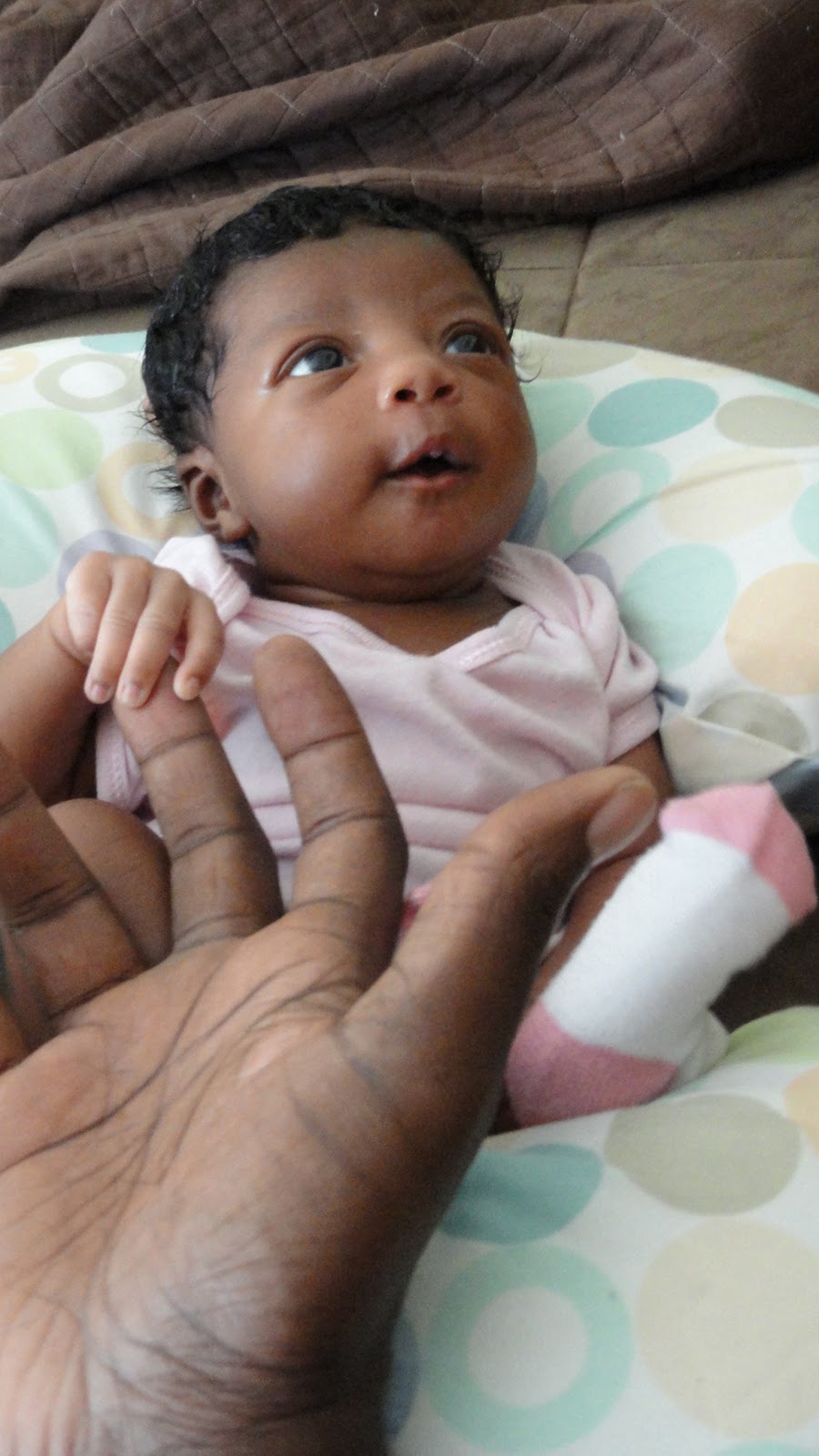
So Mini Mo hears these things from Mommy all the time, but I don't often think about the fact that Daddy's doing the same thing. This morning, when Daddy first saw his daughter, he kissed her and said, "Hey, beautiful." It was so sweet to watch them greet each other and bond, Mini Mo touching Daddy's face and smiling. *Sigh*
It's so important that our girls know that they're beautiful, and I think it's especially important that they hear it from their fathers. After all, if they're blessed to have their fathers, these men will be the most important males in their lives for years. Daddy's affirmations, then, and the lack thereof, can speak volumes in terms of these girls' self-esteem. When a loving father lifts up his daughter every day, I bet it'll be harder for some knuckle-headed boy to tear that down later on. She'll know how she should be treated and loved and hopefully won't accept anything less than that. Keep it up, Daddy!
So Mini Mo hears these things from Mommy all the time, but I don't often think about the fact that Daddy's doing the same thing. This morning, when Daddy first saw his daughter, he kissed her and said, "Hey, beautiful." It was so sweet to watch them greet each other and bond, Mini Mo touching Daddy's face and smiling. *Sigh*
| A 2-week-old Mini Mo, holding Daddy's hand--well, finger :-) |
Friday, December 30, 2011
My World Has Changed: Revisiting the "About" Section
So it's been almost seven months since my last post...but I've been a little busy. See, I was preparing for, welcoming, and now taking care of the cutest kid in my world: my new daughter, "Mini Mo." I had plans--such plans!!!--for discussing the notion that black children were better off as slaves; controversies surrounding The Help, the book and the movie; the inspiring feature article on Michelle Obama in Essence's October issue; and more. But, my world was busy changing and is still in the process of doing so. And I couldn't be more excited--or scared. This child is the sweetest, smiliest (yes, I made that up), funniest little girl. She's a dream, but she's also very much real, as are the ideas that prompted me to start this blog in the first place.
I was just re-reading my "About" section here. (Feel free to do the same.) I realized that I've felt the imperative to take care of my "village" by loving my nieces and nephews, uplifting my friends and family, helping to raise my stepson (the Kid), and taking advantage of teachable moments beyond the classroom with my students. However, now that I have a daughter, her self-esteem, her body, her images, her hair, and her (future) men are now part of my world. The ideas that inspired my very first post will be tested and challenged in raising her. This is the deepest thing I'll know, apart from marriage, and that awesome task is something I'm still trying to wrap my brain around. I hear that doesn't really change...Lol.
From now on, I imagine my posts will be conceived with Mini Mo in mind, in some way, shape or form. In a way, she makes my purpose for this outlet even more real. Cheers to that. *Clink* Happy New Year, folks. I'm looking forward to this one for more reasons than I can count, but Mini Mo is at the top.
![]() |
| Mini Mo and I during Thanksgiving weekend, 2011 |
From now on, I imagine my posts will be conceived with Mini Mo in mind, in some way, shape or form. In a way, she makes my purpose for this outlet even more real. Cheers to that. *Clink* Happy New Year, folks. I'm looking forward to this one for more reasons than I can count, but Mini Mo is at the top.
Monday, June 13, 2011
Seriously? We're Still Playing the "Black" Card?
When I read about the heavily tweeted, racist McDonald's photo that turned out to be a hoax, I didn't have the same gut reaction as most others that I saw posted/blogged--essentially, "Whoever believed this was real is an idiot." Instead, I thought, If the goal is to make McD's look bad, why does it have to involve racist sentiments against African-Americans? Is that the way to stick it to them?
It reminded me of Susan's Smith's 1994 (false) claim that a black man car-jacked her and abducted her children, whom she of course killed. It reminded me of Ashley Todd's pre-2008 election (false) claim that a black male Obama supporter robbed her at knifepoint and carved a B into her face. And then we come to find that she mutilated herself for political purposes. The idea that there's something a bit sinister about black people still plays. Hey, as silly as each of these lies were, people believed them.
These examples aren't identical to the McD's hoax. After all, the prankster's goal was to make the company, not African-Americans, look bad. Yet, that end involved the well established caricatures of black people as untrustworthy, potentially criminal, roguish--exactly the ideas Smith and Todd relied on when hiding their own demons. More than anything, it reminded me that, even in 2011, people out there still believe that they can get over on the next guy simply by vilifying black folks, whether that hope is realistic or not. Yes, these pitiful people are found out, but the attempt apparently hasn't gotten stale. To channel novice criminal Linus Caldwell's refrain from Ocean's 13, "The 'black' card plays." Dang.
![]() |
| Photo via yFrog |
It reminded me of Susan's Smith's 1994 (false) claim that a black man car-jacked her and abducted her children, whom she of course killed. It reminded me of Ashley Todd's pre-2008 election (false) claim that a black male Obama supporter robbed her at knifepoint and carved a B into her face. And then we come to find that she mutilated herself for political purposes. The idea that there's something a bit sinister about black people still plays. Hey, as silly as each of these lies were, people believed them.
These examples aren't identical to the McD's hoax. After all, the prankster's goal was to make the company, not African-Americans, look bad. Yet, that end involved the well established caricatures of black people as untrustworthy, potentially criminal, roguish--exactly the ideas Smith and Todd relied on when hiding their own demons. More than anything, it reminded me that, even in 2011, people out there still believe that they can get over on the next guy simply by vilifying black folks, whether that hope is realistic or not. Yes, these pitiful people are found out, but the attempt apparently hasn't gotten stale. To channel novice criminal Linus Caldwell's refrain from Ocean's 13, "The 'black' card plays." Dang.
Thursday, May 26, 2011
Dark Girls: The Legacy of Colorism
She's pretty - for a dark-skinned girl. I hope my baby doesn't come out with dark skin. The dark drawing represents the dumb girl. I thought my dark skin was dirt.
These are just a few of the ideas brought to light in the upcoming film Dark Girls. Please, pretty puh-lease watch this preview of the film:
Dark Girls: Preview from Bradinn French on Vimeo.
These are just a few of the ideas brought to light in the upcoming film Dark Girls. Please, pretty puh-lease watch this preview of the film:
Dark Girls: Preview from Bradinn French on Vimeo.
There are people out there who don't understand why some people - people like me! - keep preaching about the need for black people to love the way they look and to teach their children to do the same. There are people who don't see this as an issue any more. People don't still bleach their skin! Darkness isn't even an issue any more! Think again. The females in this video represent a tiny drop of black females who are made to feel lesser because of their complexions. As someone with caramel-type coloring, I haven't experienced this personally, but I've seen its effects on close relatives and on some of my dearest friends. It's real, and it doesn't seem to be going away.
And while I am very passionate about the effects of these racist ideas (both extrinsic and internalized) on black females' emotional well-being and self-esteem, I've seen these effects on black males too. I personally know little black boys who wish they had been born with lighter skin and lighter eyes, who hate to see photos of themselves because they look "too dark." Many of these boys grow up to be dark-skinned men who will never date or marry dark-skinned women, who won't hang out at the beach because they don't want to become "blacker" (carcenogic UV rays notwithstanding).
Black children's equations of darkness with all things negative has been proven time and time again throughout the years in recreations of and variations on the famous doll experiment conducted by psychologists Kenneth and Mamie Clark in the 1940s, an experiment so influential that it helped to secure the Brown v. Board of Education ruling in 1954. I encourage you to look up videos on contemporary versions of this experiment - maybe have a box of tissues handy, too.
How do these ideas continue to exist, though? I imagine it's a combination of various media - that continue to hold up light skin (and other features) as ideally beautiful while relegating darkness to the margins through virtual absence - and the passing on of internalized racism. In other words, these ideas continue to be taught. Education, then, about the seemingly simple idea of self-love is essential to reversing the centuries-old stigmas placed on dark skin. It's a task I'm engaged in right now, and I hope more and more parents, teachers, siblings, aunties, and uncles will take up the task as well.
Monday, May 2, 2011
"Talking White": Teaching Our Kids about Race
I thought “talking white” was an old-school concept. If you grew up in the 80s and 90s—maybe earlier?—as a black child who could speak articulately, you might have been told by your peers a time or two that you “talked white.” Such a statement might have been an insult, or it might have been simply an “observation,” but the point was clear: white folks spoke “clearly” or “well,” and black folks…didn’t.
Whatever the case was back then, I was surprised to discover that it’s still a thing among kids in 2011. After picking the Kid, an 8th-grader, up from school today, I engaged him in a conversation about his day. In the process, he told me how he often reads books for leisure when “[they] don’t be doin’ nothin’ in math class.” “Why are you suddenly talking like that?” I respond, to which he replies, “Oh, I’ve been hanging around a lot of black people today.” When I tell him that such language is not a “black” thing, that people of all races speak that way, he tells me a story:
Over the weekend, while on a band trip, he and one of his white female classmates were checking out their Facebook pages. After reading a post, the young lady says to the Kid, “I don’t understand this. Here. You’re black. Tell me what this means.” The Kid humorously replies with something like, “I’m not so fluent in English, but I’m attempting to become more fluent in this language [“Ebonics”?] so that I can better communicate with my people.” The young lady laughingly responds, “That was so white.” The Kid also found this funny.
This whole thing struck me as odd on one hand but not so surprising on the other. On one hand, we supposedly live in a “post-racial” society, which I never really believed in but once thought was somewhat the case for children of the 2000s. On the other hand, I know good and well that racism is alive and well, as are prejudices and firmly established stereotypes, one of which is the notion that blacks and whites “talk differently.”
There’s another matter at work here, though, and it involves the very construction of race itself. I told the Kid that he’s got to stop thinking that there is a “black” way of being and a “white” way of being, that people of all races speak the way he and his friend were mocking—it’s not a “black” thing, nor is his being articulate a “white” thing. I then told him that it reminded me of President Obama’s run for office—remember his being called “articulate and clean”?—when the Kid quickly interrupted,
“But he’s not black.”
“Well, he’s identified himself that way, and plenty of people identify him as such.”
“But his mom is white. He has her white genes!”
“What are ‘white genes’?!” I laugh. “Kid, race is a construction created by people a long time ago to create division. Now, you think you’re “black” because your mom is “black” and your dad is “black,” but you have non-black people in your blood line, in your ancestry. Does that mean you’re not black?”
“Well, not fully black.”
“So what does black mean? What makes you so different from the President? Do you see that race isn’t a fixed concept? It’s very complex and doesn’t have any one meaning.”
“Yeah, it really is complex…I’m confused…”
I could tell as much. Hey, who isn’t? He wanted to make race about skin color at times and about blood and genetics at other times. Either way, he couldn’t sustain his ideas. Sound familiar? Whatever race is or isn’t, I hope this is a more solid beginning to getting him to see the socially manufactured ways we think about race and to question the stereotypes that he’s been accepting as factual.
Subscribe to:
Posts (Atom)