About this Blog

The title of this blog, "I'm About to do My Thing," was inspired by Jill Scott's introduction to her poem "The Thickness" from her live album Experience: Jill Scott 826+. In this intro, she warns that the content to follow is "real" and proceeds to deliver a beautiful message about self-esteem in young black girls, what can influence and damage that self-esteem, and the entire village's responsibility--"it takes a village"--to elevate its children.

Showing posts with label self-esteem. Show all posts

Tuesday, September 23, 2014

Mini Mo: Reading the World "Like Me"

Mini Mo turned three years old about a month ago, and in addition to all the wonderful things other mothers have warned me about regarding this age, my little one has become quite the vocal observer of her surroundings--but more importantly of herself.

This self-observation really caught my attention a few months ago during a trip to Old Navy. To convince Mini Mo she needn't fear the half dozen mannequins that greeted us at the door, I walked to the one that looked like a young black girl with afro puffs and said, "Look! She's got puffs like you!" She unclenched my legs and eyed the mannequin, asking me to lift her so she could touch its puffs. From that day forward, whenever we go to any shopping center, Miyah looks for mannequins with "puffs like me!" (On our last trip to Old Navy just last week, she hugged the mannequin with the puffs. I'm so mad I didn't snap a photo.)

I wonder what magic is waiting in
Mini Mo's puffballs.
She continues to notice hair that looks like hers, and I encourage her observations. After all, she got that hair from me. :-) I want her to know I love my hair and her hair and that she should love her hair, too. That's why I purchased Penny and the Magic Puffballs, a children's book by Alonda Williams about a girl who comes to appreciate her puffs and the power they give her. Mini Mo was shocked to find at the end of the book a collage of photographs featuring girls of varying ages and with all kinds of puffballs--and she even thought one of them was her! She saw herself, and it was a beautiful thing.

Her reading of similarities between herself and those around her extends beyond hair these days, though. Sure, she'll note that "Daddy's wearing flip-flops like me" or "Mommy's got a necklace like me." But she's also noticing skin tone. Just the other day, she stated out of the blue, "I'm brown," to which I replied, "That's right. You are brown." She continued, "Mommy's brown and Daddy's brown." I kept her going.

"What about your brother?"

"He's brown, too."

"What about Kayla*?"

"She's white."

This exchange was a clear reminder that children grow up understanding differences (and similarities) in identities early on; it's their environment that shapes how they interpret them. I was so happy that, in this case, Mini Mo's interpretation was one of simple fact--and Kayla is one of her oldest buddies. Well, old for a three-year-old.

Beyond observing her external identifiers, Mini Mo seems to be owning her power as an individual. Let me just say: I know that her stepping into her fourth year means she has a ton of ego. Truer words were never written of this child, who really seems to have been self-assured and confident from day one. But when she sees strong, confident figures in front of her, she relates to them.

Case in point: Her aunt and uncle sent her Dr. Kimberly Brown's children's book Queen Like Me: The True Story of Girls Who Changed the World for her birthday. When hearing about the wise Queen of Sheba, the Sphinx-inspiring Nefertari and the determined Nzinga--along with Harriet Tubman, Coretta Scott King, Mary McCleod Bethune and many others--she kept wanting me to repeat these women's names. It was like she needed to be sure she got them down. She then agreed with the book's refrain that each one was "a queen like me."

Sure, she's a kid who loves books and beautiful images like any other kid, but Mini Mo's increasing literacy surrounding her identity and those of others leaves me happy about the messages she's internalizing at this young age and at this historical moment. Would she have been able to see a mannequin with afro puffs even ten years ago? Doubt it.

As she grows older and becomes increasingly aware of forces that might counter these messages, it may be harder for our family--and her teachers, I hope--to maintain them. But we're planting seeds, and I'm confident they'll bear good fruit. Besides, Mini Mo also seems to have an affinity for truth...like me.

*Not the cutie's real name

Saturday, March 29, 2014

Happy Being Me

Image courtesy of HealthWorks
*Cough, cough* Goodness--I just wiped the cobwebs off this thing. It's been a hot minute, and a lot has happened in the interim. For starters, I got a new job that has completely changed the way I prioritize my time. This blog has not made the cut--but I've missed it.

Other things have happened, things that have caused me to seriously evaluate myself. More than at any other eventful period in my life (perhaps), this phase has revealed to me that the world outside myself can really get me wrong. I've dealt with guilt (self- and otherwise imposed) for having even less time with Mini Mo each day than I had before, for having to depend on even more people to help take care of her (so blessed to have wonderful folks in my life), for having a tough time figuring out dinner most nights, for having even less inclination to de-shamble my house. I've been planning to fantabulize Mini Mo's room since before she was born, and I haven't really gotten around to it--two and half years later.

Yet, I'm proud of myself and I like myself. I dared to try something new in my life, and I'm more fulfilled because of it. I recognize my shortcomings and am cool with myself in spite of them. I teach, converse with, listen to, discipline, indulge, learn from and treasure Mini Mo. I try to make sure my whole family gets quality time together and to simply show love, even with our ridiculously busy schedules. I let my hubby know that our relationship, as the root of our family, is paramount. I'm smart, I'm funny (sometimes in ways that only I understand), I'm kind and I'm pensive. I'm working to help others--and I'm a work in progress.

But sometimes the world outside myself can make me question my plusses, the extent to which I like my otherwise confident self, and downright judge me like nobody's business. It gets to be pretty heavy at times. So the other day, I got real with myself and said, "Self, sometimes you have to encourage yourself, and you have to take some time to be happy with yourself." The time I spent doing both of those things was invaluable, and I have a new commitment to them, to myself. More importantly, I think this attention to myself will make me a better woman, wife, mother, friend and person.

I'm not perfect, but I'm feeling myself--and I'm not counting on others to do that for me. I simply don't have time.

Friday, January 4, 2013

"Natural Isn't for Everybody"...Er?

My crew and I represent a range of looks and preferences,
and we love and respect those preferences! Here we are in
October 2012.
Look, sisters, I respect the fact that "our hair"--kinky, curly, nappy, kinky-curly, whatever you want to call it--can accommodate a broad range of looks, styles, textures, you name it. It's very cool to witness this spectrum of looks.

When some sisters cry, "Natural isn't for everybody," then, I have to wonder what they mean. I just want to throw these tidbits of agreement out there (but I don't think it's what some of them mean):

  1. Taking care of natural hair is not for everybody--so true. Some sisters have no idea how to comb, moisturize, style, or otherwise maintain kinky, coily hair. They never had to learn, so learning as an adult is overwhelming for some women who'd rather dispense with the drama of learning. Hey, I hear ya.
  2. Certain styles are not for everybody--amen. Maybe a fro-hawk on one lady is not so cute on another. Maybe one woman's texture is perfect for a huge halo of hair to encircle her head, but maybe another woman's hair doesn't kink up enough to achieve the same kind of halo. Everything doesn't work for everybody.
What I really think some of these ladies are suggesting, though, is that sporting the natural texture that grows out of one's head is not for everybody, that some women "need" relaxers. To that, I cry, "Ridiculous!" How can wearing one's hair the way it naturally grows not "be for" that person? That's the way it was growing before relaxers touched it, yes?

To each her own in 2013 and beyond, ladies. You want to loc it up, weave it up, fry it up? Cool. We all have preferences, but let's embrace the diversity we see in each other, a diversity that is just now becoming acceptable in many ways. That is a beautiful thing, so let's respect it and each other.

Thursday, January 12, 2012

"Hey, Beautiful": Daddy's Words are Precious

I tell Mini Mo that she's beautiful several times a day, every day: "Good morning, beautiful!" "Hey, pretty girl!" "What's my beautiful girl doing?" I often follow one of these greetings with, "You're beautiful, but that's not the most important thing about you. What's in your head and heart count the most, and remember that your beauty doesn't make you better or more special than anyone else." Mini Mo's only 4 months old, but these lessons must start early! Lol.

So Mini Mo hears these things from Mommy all the time, but I don't often think about the fact that Daddy's doing the same thing. This morning, when Daddy first saw his daughter, he kissed her and said, "Hey, beautiful." It was so sweet to watch them greet each other and bond, Mini Mo touching Daddy's face and smiling. *Sigh*

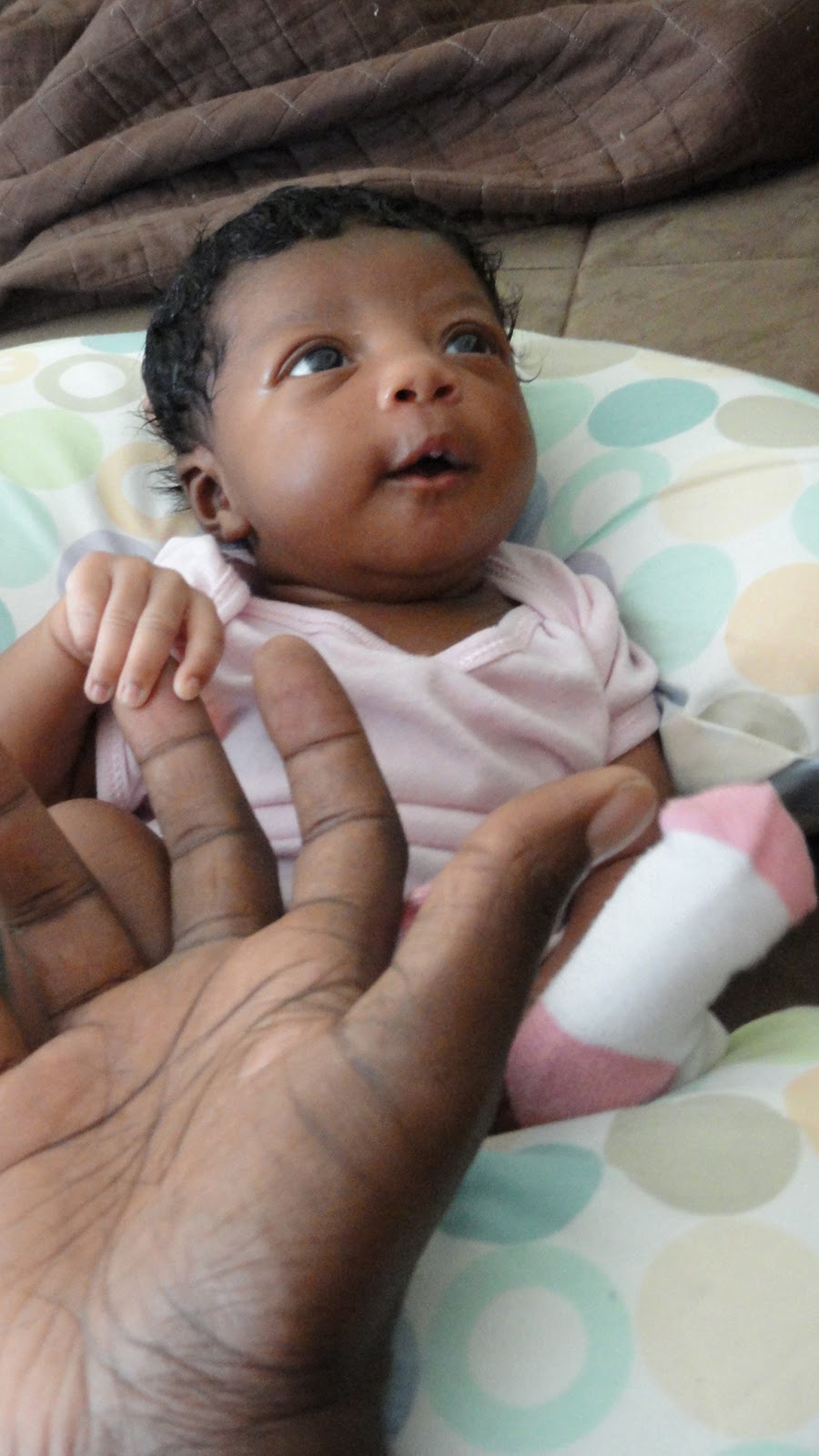
A 2-week-old Mini Mo, holding Daddy's hand--well, finger :-)
It's so important that our girls know that they're beautiful, and I think it's especially important that they hear it from their fathers. After all, if they're blessed to have their fathers, these men will be the most important males in their lives for years. Daddy's affirmations, then, and the lack thereof, can speak volumes in terms of these girls' self-esteem. When a loving father lifts up his daughter every day, I bet it'll be harder for some knuckle-headed boy to tear that down later on. She'll know how she should be treated and loved and hopefully won't accept anything less than that. Keep it up, Daddy!

Monday, November 1, 2010

"Sesame Street" Teaches Kids AND Adults to Love Their Nappy Hair!

I don't know if I'm alone in this, but I've been walking around singing, "I love my hair! I love my hair..." ever since I first saw the now-viral video of a 
Singing, "I want to make the world aware: I love my hair!"
cute, happy little Sesame Street
muppet singing about how much she loves her hair--her kinky hair. :-) (Shout-out to Brenna, Paul and Dubose for sharing!) During the video (clicking the image to the right will take you to the YouTube video too), she's ecstatic about all the things she can do with her hair: wear it in twists, let it fly freely or rock a 'fro, among other things.

This video has inspired so many women (and some men too) with pride in a muppet who doesn't "need a trip to the beauty shop 'cause [she likes what she's] got on top." It made me wonder who the real audience is for this song. Sesame Street historically has been geared toward pre-schoolers, but I can't count how many comments I've read in which grown women reflect on their girlhood days, wishing they had seen a such appreciation and embracing of natural hair on TV.

If you were coming up in the '90s and earlier, you just didn't see or hear ideas like this in the mainstream. Nappy hair was destined to be pressed, Jheri-curled, or relaxed past a certain age. I think I just hit it: braids and twists and afro puffs are markers of girlhood--at least they have been. If I'm right, though, this precious video (the brain-child of a head writer for Sesame Street) is a symptom of changing times. Increasingly, it's becoming acceptable for females of all ages to "love all the things their hair can do." I hope it keeps up in high school, in relationships, in the business world, on job interviews, in academia, and in the mirror.

Monday, July 19, 2010

Black Girls: Still Big Booties and Pu**y? (That's not putty...)

OK, WTH?! This was my immediate reaction upon coming across the Google search results for “black girls” that are displayed in this image (right). (Note the sponsored links, too.) Mind you, I was searching for an organization, Black Girls Rock, Inc., that I had come across months ago and wanted to revisit. I couldn’t quite remember the name but knew that black girls was part of it.

Now, I really don’t want to get into a ramble about historical depictions of black women as lusty, animalistic, lewd sex-toys—trust me, I could go there—but the irony of this situation is troubling in itself. For the last few years, I’ve been mulling over the idea of a non-profit organization designed to help young black women combat the afore-mentioned negative images, particularly as cultivated in various aspects of hip-hop culture, music videos, films, and print media. Black Girls Rock, Inc. is an organization that does such work, and I wanted to peruse it for inspiration. (Adding inc. to my search got me to the right site, by the way.)

But alas, of the first seven entries that appear in these Google search results, only one of them does not relate to black women as purely sexual objects. And these are the top results of 276 million. What causes this particular content to appear first in a search for “black girls”? Well, I had to do a little research.

Determining search results and ranking them are complicated processes that involve some pretty fancy computing (all kinds of algorithms and such that I know nothing about), but the quality of web pages is an important consideration in ranking search results. In a newsletter called Librarian Central, Google gives librarians various teaching tips, one of which deals with search engines. In an issue titled “How Does Google Collect and Rank Results?” Google offers this information after having provided material on data collection:

Now we have the set of pages that contain the user's query somewhere, and it's time to rank them in terms of relevance. Google uses many factors in ranking. Of these, the PageRank algorithm might be the best known. PageRank evaluates two things: how many links there are to a web page from other pages, and the quality of the linking sites. With PageRank, five or six high-quality links from websites such as www.cnn.com and www.nytimes.com would be valued much more highly than twice as many links from less reputable or established sites.
This is interesting information. According to Google, it prizes foremost the number of sites that link to pages containing the items in the query (in my case, the number of sites linking to sugaryblackpu**y.com and the like) and then the credibility of those sites. This leads me to wonder, Where are the “quality” portals of information that positively discuss black girls? That’s not to say they don’t appear somewhere in those 276 million results, but they’re clearly not as prominent as those sites linking to pages that perpetuate an idea of lewd black female sexuality.

Apart from the numbers and quality of web pages that link to the words in a searcher’s query, Google states that relevance is a key determiner in ranking results:

As a rule, Google tries to find pages that are both reputable and relevant. If two pages appear to have roughly the same amount of information matching a given query, we'll usually try to pick the page that more trusted websites have chosen to link to. Still, we'll often elevate a page with fewer links or lower PageRank if other signals suggest that the page is more relevant. For example, a web page dedicated entirely to the civil war is often more useful than an article that mentions the civil war in passing, even if the article is part of a reputable site such as Time.com.
Because the sites that link black girls with hot sex are so much more abundant than those that don’t, the relevance factor appears to be more important than the reputability factor here. What’s relevant regarding black girls appears to be those who are involved in porn. Hmmm…

I’m not out to attack Google, though. The company is only collecting and sorting data. My concern is that, in 2010, so many users of the World Wide Web are more interested in black girls for their big booties and pu**ies than, say, for their creativity, beauty, or anything not related to their anatomy.

It’s not like black girls are unaware of this interest. Any given day, you can see young black females in skin-tight, low-rise, hip-hugging jeans or shorts that look like underwear with their booty cheeks all out (check out Jill Scott's "The Thickness"!). Why? Is it because such looks are trendy, attractive to males, or plastered all over videos and magazines? It’s likely that all these possibilities hit the nail on the head, but the important thing is that so many of our girls want to emphasize their sexuality when they walk out of the door. The curves are given top priority, and this valuing of the body isn’t spawned in a vacuum. It’s cultivated by so many forces in the world we live in.

That’s not to say that there’s anything wrong with females embracing their sexuality. In fact, the ability to do so is one of the triumphs of feminism and other movements that now allow females the freedom to express themselves. However, when that freedom privileges sexuality, then we have children growing up placing their self-worth in their curves and in attracting interest in those curves. Where’s the true self-love in that, the value of a woman’s essence that doesn’t reside in her anatomy?

That’s also not to say that young black females are the only ones who wear revealing clothing. Of course, women of all shades, sizes and ages dress this way. But I’m focusing on this style of dress in conjunction with the historical images of black women (that have not died) and the clearly continued fascination with black women’s supposedly animalistic lust, as evidenced by the associations that web users make between black females and their sexuality.

It’s clear that if we parents, sisters, brothers, aunts, uncles, cousins, teachers, preachers, and friends don’t educate black girls about their inherent value, apart from their bodies, then there’s a whole world, a whole culture out there willing to educate them instead. Maybe my now-foggy ideas about an NPO will eventually become a real entity that counteracts these views of black females. Thank goodness for programs like Black Girls, Inc. and Hot Girls, Inc. that are undertaking this work now. But the truth is this: we have to do this work for the good of our daughters and their progeny, or else we’ll never see the end of centuries-old ideas that encourage black women to love their big booties and their pu**ies while truly hating themselves.